
WHAT'S NEXT JOURNAL: VOL. 5 - July 2026
BIG NEWS AHEAD
Something we have been working on for a long time is almost ready to share.
In the coming weeks we will have news about a publication that sits at the heart of everything What's Next has been building — including a pre-order date, a release date, and a first look at what is inside. We are also in the middle of revamping our website, where you will find much more information on all of this very soon.
It has been a full and meaningful month. Thank you for being part of this conversation.

It has been a full and meaningful month.
Thank you for being part of this conversation.
HAPPENING AT WHAT'S NEXT
July brought two significant developments. For the first time, we publicly introduced the Perennial Careers framework, the idea that has been central to our work and our forthcoming publication. We look forward to sharing more about it with you.
Our website is also being redesigned to better reflect what What's Next has become: a thought leadership platform, a research archive, and a growing community of professionals rethinking what a career can look like across a longer life.
More on both, very soon.
INTRODUCING: THE PERENNIAL CAREER
One of the questions we hear most often from people contemplating a career change is this: is it okay if I do not know what comes next yet? Behind that question is usually another one. Am I falling behind?
These sentiments tell us that the career model we have been taught no longer fits our lives and needs. Careers were designed for shorter lives and linear trajectories. Most of us were taught that pauses, detours, and changes in direction were interruptions to the plan. But what if they are the plan?
This month, we introduced the Perennial Careers framework. Naming our framework, we took our inspiration from nature. Perennial plants return year after year from their own roots. Their dormant periods are not signs that growth has stopped. They are part of how growth happens. We believe careers work in much the same way. A perennial career moves through seasons of growth, pause, reinvention, and renewal without losing its foundation. Nothing is wasted. Experience accumulates. Identity deepens. Each chapter becomes material for the next.
A perennial career is not a career interrupted by change. It is a career designed for it.

OUR WRITING
The Multigenerational Workplace: Five Generations. One Floor. A Design Problem Nobody Has Solved.
For the first time in modern history, five generations are sharing the same workplace. Most organisations are still managing them the wrong way — not because of generational differences, but because of an organisational design that was never built for this reality. The tensions attributed to generation are almost always something else entirely. What needs redesigning is not the conversation but the career architecture itself.
The Missing Architecture of Longer Careers: We Added 30 Years to Life, But Not to Work
We extended the human lifespan without extending the infrastructure that supports it. Career development stops at 40. Training investment drops after 45. The systems around us were built for working lives that ended decades earlier than ours will. This piece explores the structural gap between how long we are actually going to work and how little exists to support that reality.
WHAT WE HAVE BEEN READING
Ageism: The Silent but Deadly Threat to Your Retirement
Claer Barrett, Financial Times
Barrett writes about Stacey Duguid, a 52-year-old former fashion editor who has spent 16 months submitting hundreds of unanswered job applications. She has removed her age from her CV and cut 20 years of experience to avoid algorithmic screening. "The money's running out, and I'm frightened. If I'm in this position, maybe you are too?" The response she received confirmed what many already suspected. She was not alone.
What Barrett names so precisely is the collision between two realities rarely discussed together. Millions of people are depending on longer working lives to fund their retirement, while the hiring systems they navigate were never designed to include them. Age bias rarely announces itself. It arrives in automated screening tools, in job description assumptions, and in the habitual preference for someone younger. As Lynda Gratton notes in the piece, your forties are the pivotal moment to begin actively designing the next 30 years of work. The work What's Next exists to support.

Research: As Careers Get Longer, Midcareer Work Needs to Change
Lynda Gratton, Harvard Business Review
Longer lives mean our parents will also be living longer, and may need our care for extended periods. Midlife is becoming an increasingly overloaded chapter: peak professional responsibility alongside caregiving, family commitments, and questions about what comes next. When professionals fail to manage all of it, organisations tend to interpret this as an individual resilience problem. Gratton's research suggests it is a design problem. If careers are becoming longer, we cannot simply stretch existing models across more decades. We need new structures for reflection, reinvention, and renewal throughout a working life. For years, organisations have focused on developing early-career talent and managing retirement. The most important stage may be everything in between.
5 Questions Leaders Should Ask Before Turning to Fractional Work
Joy Batra and Dorie Clark, Harvard Business Review
Fractional work is often discussed as a solution. Less often do we ask what problem it is actually solving. Batra and Clark argue that the question should not be whether a role can be done fractionally, but whether the organisation understands what expertise it needs and what outcomes it expects to achieve. What interests us most is the broader signal: fractional work challenges assumptions that have shaped careers for decades — one employer, one identity, one path forward. People are not only rethinking where they work. They are rethinking the structure of work itself.

OECD Longevity Readiness Tool
OECD
The OECD has launched a practical framework to help organisations assess how ready they are for longer working lives, examining four areas: recruitment, training, job quality, and health and wellbeing. What strikes us is not the tool itself but what it represents. For years, longevity has been discussed as a health issue, a retirement issue, or a demographic issue. It is becoming a leadership issue. Longer lives are not simply extending careers. They are exposing the limitations of career models and workplace assumptions built for much shorter lifespans. Longevity strategy is incomplete without career strategy.
THE NEXT SHELF
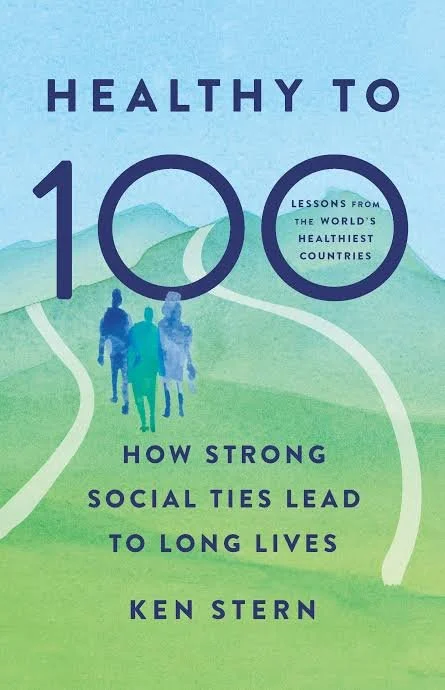
Healthy to 100: How Strong Social Ties Lead to Long Lives
Ken Stern
The strongest predictor of longevity is not diet, exercise, or genetics. It is the quality of social connections. Ken Stern , host of the award-winning Century Lives podcast from the Stanford Center on Longevity, travelled to some of the world's longest-lived countries to understand what they share. The answer was not food or fitness. It was intergenerational connection, purpose, and the way older people are seen and included.
Rather than treating aging as an individual challenge to solve, Stern invites us to think about it as a collective design question: how do we create communities, workplaces, and societies where connection does not diminish with age? One of the most important books in the current longevity conversation.
BEFORE WE GO
If you have spent the last few years in a role that no longer quite fits — not because you have failed, but because you have changed — what would it mean to treat that feeling as information rather than a problem?
We would genuinely like to know. Write to us at hello@w-next.co, or find us on LinkedIn and Instagram.
If someone in your network is rethinking what comes next, or simply curious about the future of work, we would be glad if you shared this Journal with them.
What's Next is a platform for professionals navigating midlife career transitions. rounded in research, it is built for connection, and committed to making reinvention feel less like a crisis and more like a design choice.
